
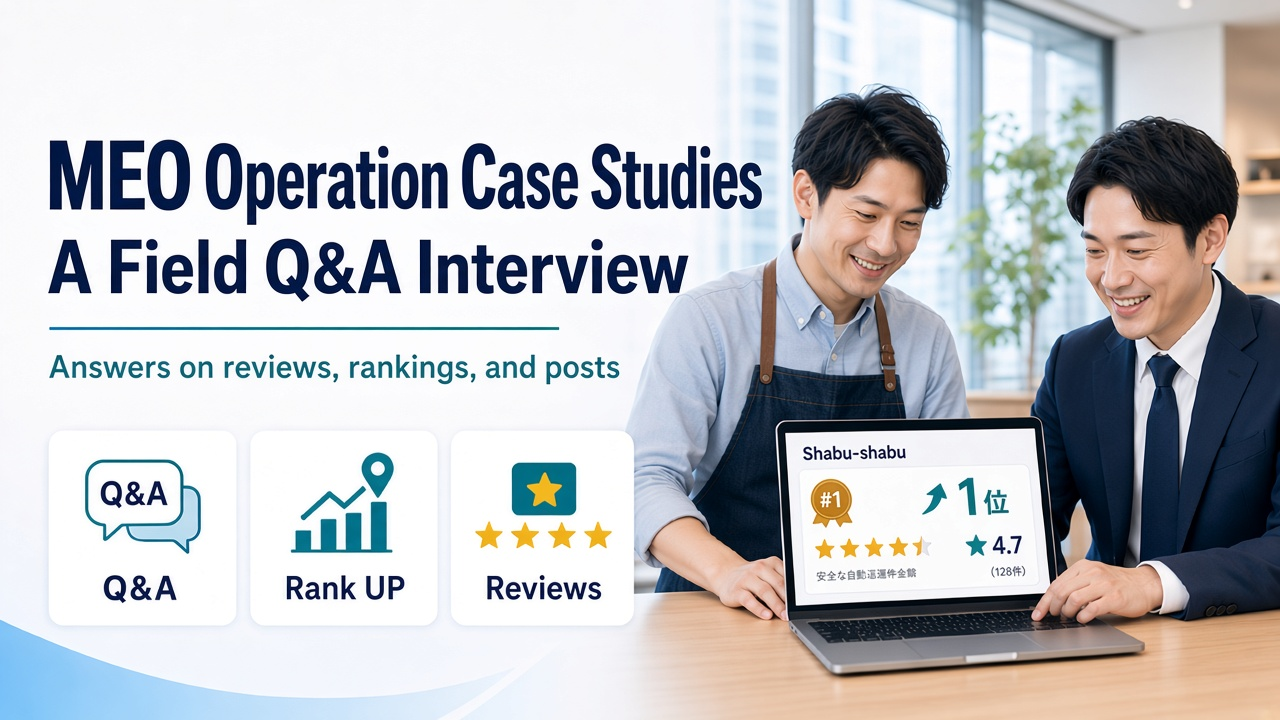
“How many reviews should we collect?” “How long until we see results?” “Can we rank for big keywords too?” — once you start MEO work, questions like these keep coming up.
This article organizes real conversations from Omakase MEO operations into an interview format. Results always depend on industry, area, and competition, so there is no single formula — but concrete store examples and a clear priority order for tactics should be easy to picture.
Cast
Role | Role description |
|---|---|
Interviewer | Voices common questions from stores and agencies |
Omakase MEO | Answers from an operations and consulting perspective |
Q1. How many reviews do we need? When do results show?
Interviewer
I’d like a rough target for review volume, and how long it takes before visit impact appears. I’m also curious how to compare scores with competitors.
Omakase MEO
Score comparison with competitors is relative, not absolute. There is no universal “safe number” — it depends on how dense the area is and on the industry.
Even if you have 100 reviews and rank #1 for a keyword you care about, you can drop when competitors raise their score, so ongoing work is essential.
That said, here is one case from stores we support:
Okinawa shabu-shabu restaurant (top-tier / “hyakumeiten” class)
About four months after starting Omakase MEO, map search rank for the keyword “しゃぶしゃぶ” (shabu-shabu) rose from #2.8 → #1.
Average rating 4.7, cumulative reviews 300+.
Reviews are covered with auto-replies, and every Instagram post is mirrored to GBP. By using Omakase MEO features, they steadily built score and won — and held — #1.
Think of it not as “X reviews in Y days guarantees a rise,” but as a case where systematizing review growth plus replies and posts moved the ranking.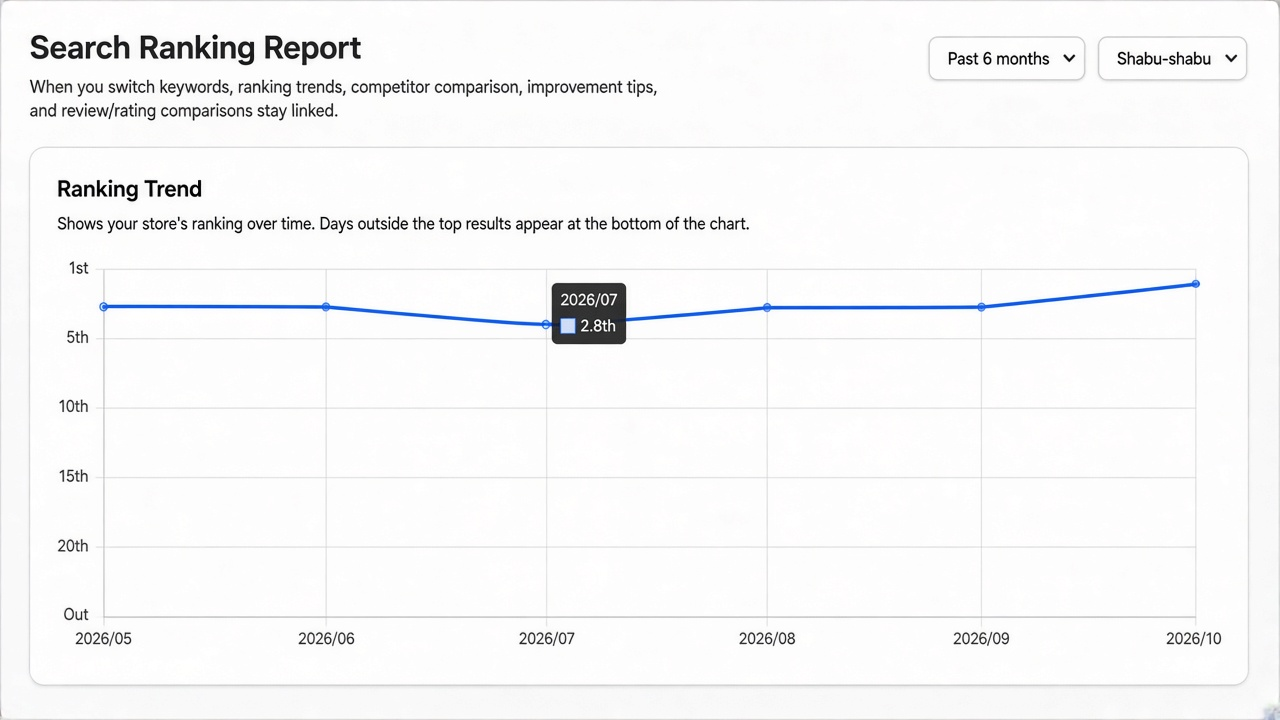
Q2. Which keyword hit #1? How many reviews were added in that period?
Interviewer
Please tell us more about the Okinawa shabu-shabu store.
Which keyword moved from #2.8 to #1?
How many reviews were added in that period? (Is “300+” cumulative?)
What effect does Instagram mirroring have on GBP? Does it affect ranking algorithms?
Omakase MEO
1. The keyword is “しゃぶしゃぶ” (shabu-shabu)
The core keyword for action and measurement was “しゃぶしゃぶ” — the store’s main battlefield. Not overly niche, and strong purchase intent; that is the case where rank improved.
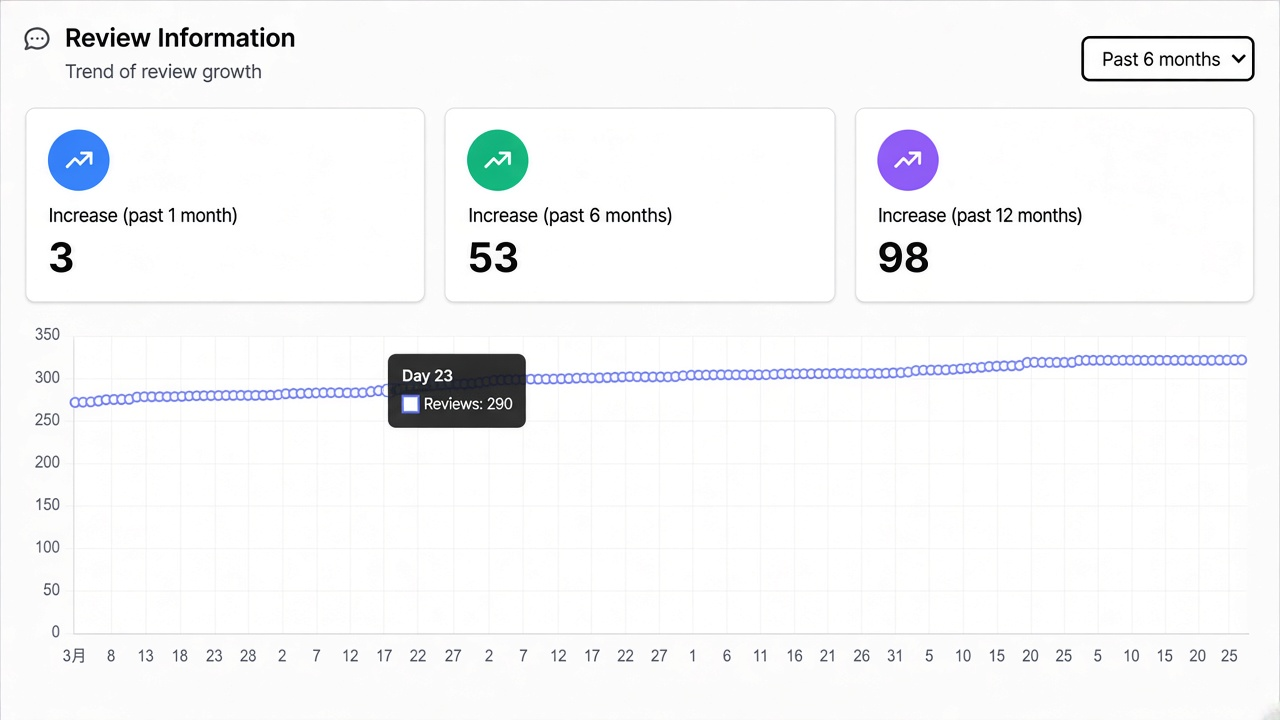
2. About 50 new reviews in the period (300+ is cumulative)
Reviews added after onboarding were about 50. The “300+” shown on the profile includes earlier cumulative volume.
In Omakase MEO you can also chart review growth, so you can look back with numbers — not gut feel — at when and how much volume increased.
3. In practice, posts are widely seen as helping “prominence”
Google’s official help says local results are influenced by relevance, distance, and prominence (see: How business information appears on Google).
“Prominence” is a mix of reviews and other web signals; there is no published coefficient for posts alone. Still, MEO practitioners widely share the rule of thumb that ongoing GBP posts help freshness and awareness. The fact that post-focused tools exist reflects that demand.
With Omakase MEO, everyday Instagram work can mirror to GBP — so instead of adding a separate posting chore, you carry existing content onto Maps and support the prominence side that way.
Q3. Niche keywords like “かき氷” (kakigori) can score high. What about big keywords?
Interviewer
Two other stores reportedly rank #1 for “かき氷”.
On the ground, though, it often feels like you need to expand into bigger words like “カフェ” (café) or traffic won’t grow.
In a tough market like Omotesando in Tokyo, is a high rank still realistic? It feels different from regional markets.
Omakase MEO
Exactly — the number of searches people make also changes. Even with #1 on a niche term, if you never expand profile, categories, and post language toward higher-volume words, map-driven visits may stay limited.
If you want growth on “カフェ”, a realistic order is:
Weave café elements into the store and naturally include the target words in the Business Profile (name, categories, description, and so on)
Keep promoting the same word axis in GBP / SNS posts
Confirm before/after ranks with Omakase MEO keyword tracking
How high you can go in a competitive area cannot be promised without analysis. By setting keywords to measure, you can compare review volume and ratings of stores currently on top.
Around Omotesando, competitor analysis sometimes shows patterns like these (examples / hypotheses):
Strong volume and rating, yet still losing on rank
Lots of no-text (silent) reviews can make the same count feel weaker on keywords
In practice, review “weight” is often discussed roughly like this:
Review content (image) | Relative weight (hypothesis) |
|---|---|
With photos | Heavier |
With text | Medium |
Silent (stars only) | Lighter |
※ The scoring above is not official Google guidance — it is field hypothesis and experience. Still, designing for more photo + text reviews / fewer silent-only reviews is usually easier to recommend than chasing count alone.
Posts, like reviews, often create a gap between “present” and “absent.” The bigger the keyword, the more you need profile work + ongoing posts + higher-quality reviews as a set.
Q4. Where do we “set” the keywords we want to rank for?
Interviewer
Can we set target keywords somewhere in Omakase MEO?
Omakase MEO
There is no “always make this keyword #1” switch. Priority order for tactics is:
① Put target keywords into the Business Profile (MEO writing)
How you name the store, categories, and business description — weaving in target phrases naturally — is step one.
For an izakaya, for example: “Banquets, after-work drinks, dates, and business dinners are all welcome. A 7-minute walk from Shinjuku Station and 1 minute from Yoyogi Station — easy to drop by after work.” That kind of MEO writing puts words people actually search into the profile.
② Do MEO writing in posts too
If you want to expand “café,” keep running café-oriented promo posts. Mirror Instagram to GBP and those words reach Maps as well.
③ Track rank changes with measurement keywords
Omakase MEO’s keyword ranking analysis lets you check daily where you stand after taking action. The setting is for running PDCA with numbers, not a magic switch.
Business info management and AI-assisted GBP posts are also in Omakase MEO. Versus updating GBP entirely by hand, it fits teams that want to cut workload while staying on the same strategy.
Q5. How is agency collaboration (B2B2X) going?
Interviewer
Beyond stores, we also hear about working with agencies. How is that progressing on the ground?
Omakase MEO
Omakase MEO is advancing B2B2X. More agencies that already run MEO businesses are choosing Omakase MEO to cut their own operational load. We do not compete with regionally rooted agencies that support stores day to day; relationships stay as they are, and Omakase MEO specializes in a collaboration scheme that delivers workload reduction for MEO operations.
Repetitive work — review replies, post mirroring, monthly reports — moves into the system, so agencies can focus on human value such as improvement work and staff training. Weekly and monthly analysis reports are auto-generated in Omakase MEO, so you also cut the load of “someone building analysis decks from scratch every month.”
For more on the B2B2X approach, see this article as well.
Key takeaways from the case studies
Topic | Field answer |
|---|---|
Review volume target | Relative to competitors, not an absolute. Example: ~4 months after launch, “shabu-shabu” #2.8→#1; ~50 added in period / 300+ cumulative; rating 4.7 |
How results appear | Depends on industry and area. Validate with keyword tracking and reports |
Instagram mirror posts | A practical lever for prominence / freshness; keep GBP updated with near-zero posting labor |
Niche vs big keywords | Keep niche #1s, and expand into bigger words via profile and posts |
Competitive areas | Don’t promise ranks; analyze. Review quality (photos, text) and posts as a set |
Keyword setup | Profile → posts → measurement. Not a single switch |
Agencies | B2B2X balances workload reduction with store support |
Closing | Grow map ranks with near hands-off operations
What the Omakase MEO cases show is a simple structure:
Collect reviews and reply to all of them (auto-reply)
Mirror everyday Instagram posts to GBP (near-zero posting labor)
Weave target keywords into profile and posts, and track with numbers
There is no “X reviews guarantees a rise.” Still, as with the Okinawa shabu-shabu store, months of systematized operations can move rank substantially.
Where do you stand on your keywords today, and how do competitor review volumes look? Starting with measurement and a profile review is a solid first step.